Guides
AI Book Finder: Find a Book When You Only Remember Fragments
An AI book finder turns a vague memory into a title. Here's how it actually works, what kinds of fragments are enough, and when it beats Reddit, Google, or ChatGPT.
A lighthouse keeper. A baby washed ashore. A wife who can't have her own.
That's three details. No title. No author. No year. And for an AI book finder, that's plenty.
You don't need to remember what a book was called to find it again. You don't need to remember who wrote it. You need to remember something — a scene, a feeling, the color of the cover when it sat on your nightstand.
What an AI book finder actually does
A regular search engine matches words. Type lighthouse keeper baby washed ashore into Google and you'll get news articles, Reddit threads, and twenty pages of unrelated SEO content. The words don't add up to a book.
An AI book finder doesn't match words. It reads your description the way a friend would. It pulls out what's distinctive (a lighthouse keeper, a foundling), what's mood (a small island, a quiet moral problem), and matches that against everything it knows about books. Plot summaries, settings, characters, themes.
It's not magic. It's pattern recognition against a catalog. The trick is that the matching is loose enough to work with messy human memory, and tight enough that a lighthouse keeper and a foundling doesn't return every quiet historical novel.
Why a fragment is enough
We've answered more than 40,000 book requests in the last four months. The median description is 20 words. Two sentences. "A boy who could see ghosts but pretended he couldn't. He lived with his aunt." That's the median. We pulled apart the descriptions readers send us most often if you want to see the patterns in the data.
Most of those searches surface a shortlist worth scanning. The ones that come up empty are usually books we don't have catalog data on yet: pre-2000 self-published titles, foreign-language editions, very obscure children's books. The Reddit category.
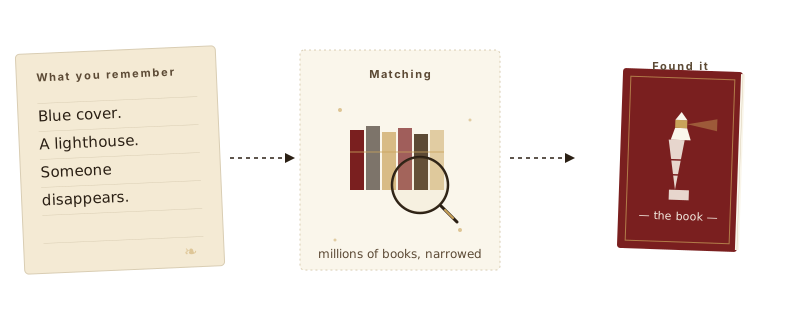
Why does this work with so little input? Because there are only so many books that fit any vivid detail. The first thing you remember, the one specific thing, is almost always enough to cut the search space from millions down to dozens. Everything after that is just narrowing.
A lighthouse and a disappearance is a single book most of the time. Two memorable details, and you're done.
What kinds of memories work best
Some memories give the AI more to work with than others. Here's what helps, roughly in order:
A specific scene. "She finds her grandmother's letters in the attic." A vivid scene is the strongest signal you can give. It usually picks out one book, instantly.
A character's name, even a first name. Books rarely share unusual character names. "A protagonist named Elodie" narrows things down fast.
The setting plus a feeling. "Gothic boarding school, slow dread." Genre alone is too broad. Setting and tone together get specific.
A cover detail. "Hardcover, dark blue, a small white house on it." More useful than people expect. Covers are designed to be memorable.
When you read it. Not the year of publication, when you read it. "Around 2012, in middle school" eliminates thousands of options.
What doesn't help much: "It was really good." Every book somebody is trying to find was really good. Same with "it was a thick one." Page count helps the least.
If you only remember the plot, we have a page built for that. If you only remember the genre, we can help narrow it first.
Try it now
Pick the one thing you remember most clearly. The cover, the ending, a scene, a feeling. Type it in below, however you'd say it out loud. We'll take it from there.
AI book finder vs the alternatives
There are five places to ask "what was that book." Each one works for a different kind of memory.
| Method | Best for | Speed | Effort |
|---|---|---|---|
| AI book finder | Vague descriptions, fragments, mood | Seconds | Type a sentence |
| ChatGPT | Confirming titles you already half-know | Seconds | But it hallucinates titles |
| r/whatsthatbook | Obscure, childhood, vibe-only books | Hours to days | Write a post |
| Specific phrases, unusual names | Seconds | Need a quotable detail | |
| Goodreads groups | Partial titles, genre fragments | Days | Browse and post |
ChatGPT is the one to be careful with. It happily invents books. Titles and authors that don't exist. We've seen people search for ChatGPT-suggested titles, find nothing, and assume their memory was wrong. Their memory was fine. ChatGPT made the book up.
Reddit's r/whatsthatbook (320,000+ members) is genuinely the best human option, especially for childhood books. The tradeoff is wait time. You're depending on someone else recognizing your description. For obscure stuff, that's the move. For anything reasonably well-known, an AI book finder is faster.
A real example, end to end
Here's what an actual search looks like.
"I read this book when I was probably twelve, in the early 2000s. It's about a boy who can see ghosts but pretends he can't. He lives with his aunt. There's a graveyard nearby and the ghosts in it want to tell him something. The cover was dark blue or grey."
Five sentences. No title, no author. The AI picks out the distinctive parts: a boy who sees ghosts, an aunt as guardian, a graveyard, ghosts trying to communicate. It runs that against everything it knows. One book fits cleanly.
The Graveyard Book by Neil Gaiman. The "aunt" detail is slightly off (in the book it's a couple who raise him), but the rest is exact. That's how the matching shrugs off a misremembered detail. It leans on the strong signals (ghosts plus graveyard plus boy protagonist plus early-2000s YA) and doesn't get hung up on any single weak one.
What AI book finders can't do (yet)
Honesty: we don't get it right every time. Two-thirds is good, not great. The hard cases:
A single ambiguous detail with no context. "A book with a red cover." That's hundreds of thousands of books.
Misremembered details that contradict the real book. "It was a science fiction novel set in Paris." If the real book is fantasy set in Rome, the AI struggles to override your stated genre.
Very obscure or unindexed books. Self-published 1980s children's titles. Foreign-language editions that never crossed over. Out-of-print regional press. The longer the tail, the more likely a Redditor with a good memory beats us.
For the obscure cases, post on r/whatsthatbook with everything you remember. The community's collective memory is unreasonably good, and for those books, no algorithm we know of catches them.
Frequently asked questions
From the reading desk
That book you've been trying to remember? It's probably less unfindable than you think. The thing you remember most vividly is the one you can find it by.
If you want a deeper walkthrough, we wrote five ways to find a book you can't remember. If your memory is mostly plot, the find a book by plot page is the shortest path. If "name that book" is the phrase your brain keeps repeating, we cover that exact framing. And once you've found your book, you can discover similar reads.
The Shelf Note
Get the strangest book mysteries in your inbox
Forgotten plots, reader searches, new quizzes and book games, plus the occasional member-only find.